SocialRouter
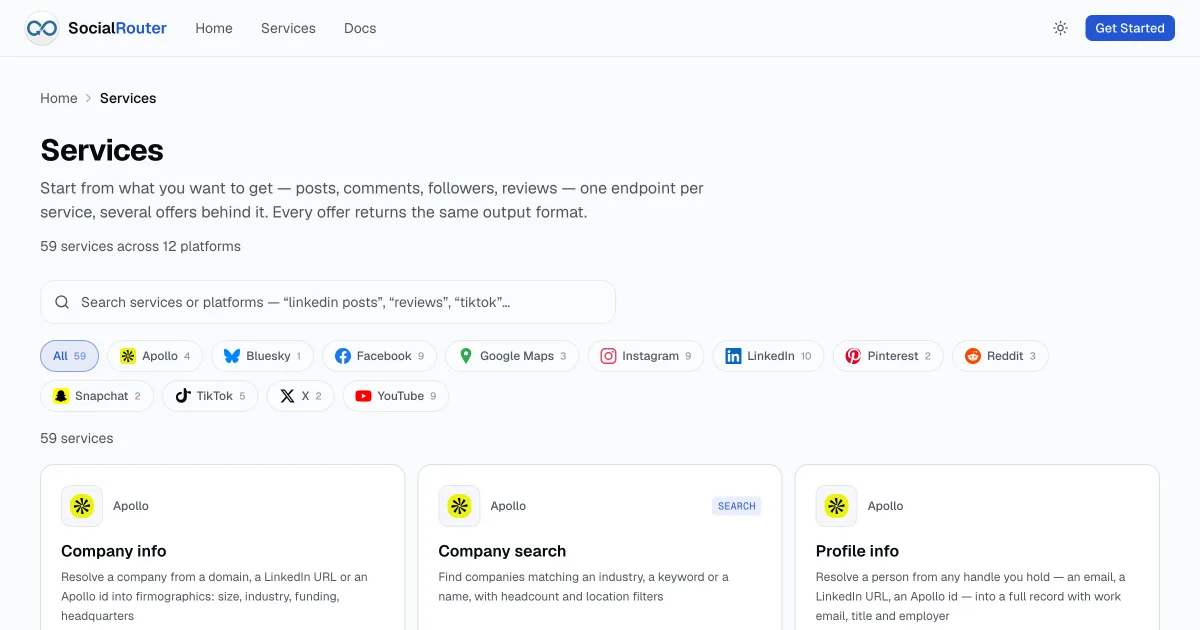
Pulling data from social networks means choosing between dozens of scrapers and datasets, each with its own account, API, rate limits, and output format. Add a network and you start over; when a provider gets blocked, you rebuild. Our client needed reliable social data without tying their product to any single source. It was the same problem LLMs had before OpenRouter.
We built SocialRouter: one integration that covers every provider. The client asks for a type of data, such as a profile or a post's likes, and the router sends the job to the best available provider. If that provider fails mid-request, the next one picks it up without the client noticing. Every provider returns the same format, and the client is billed only for the records that come back.
Every request runs through a routing engine that checks the input, looks for a cached answer, ranks the providers that can serve it, and works down the list until one succeeds. The data comes back in a single format, and the response records which provider answered and whether the router had to fall back.
The platform ships as a full stack: a hosted API, a public catalogue of every service and its price, a dashboard for keys and billing, an MCP server for AI agents, and client libraries for the main languages. Supabase row-level security controls access to credits and keys, and Stripe runs the usage-based billing.
Routing and caching sit in the core. Repeat requests are served from the cache, and a failed attempt earlier in the chain is never charged.
The client's team integrates once and reaches every provider, using it to source leads, track competitors, watch for signals, or feed social data into n8n, Make, and Zapier. The MCP server gives their AI agents the same access as a single tool, and any scraped text is flagged as untrusted so an agent treats it as data rather than as instructions.
Let's ship infrastructure that scales with your business
Book Your Strategy Call