AI Lead Engine
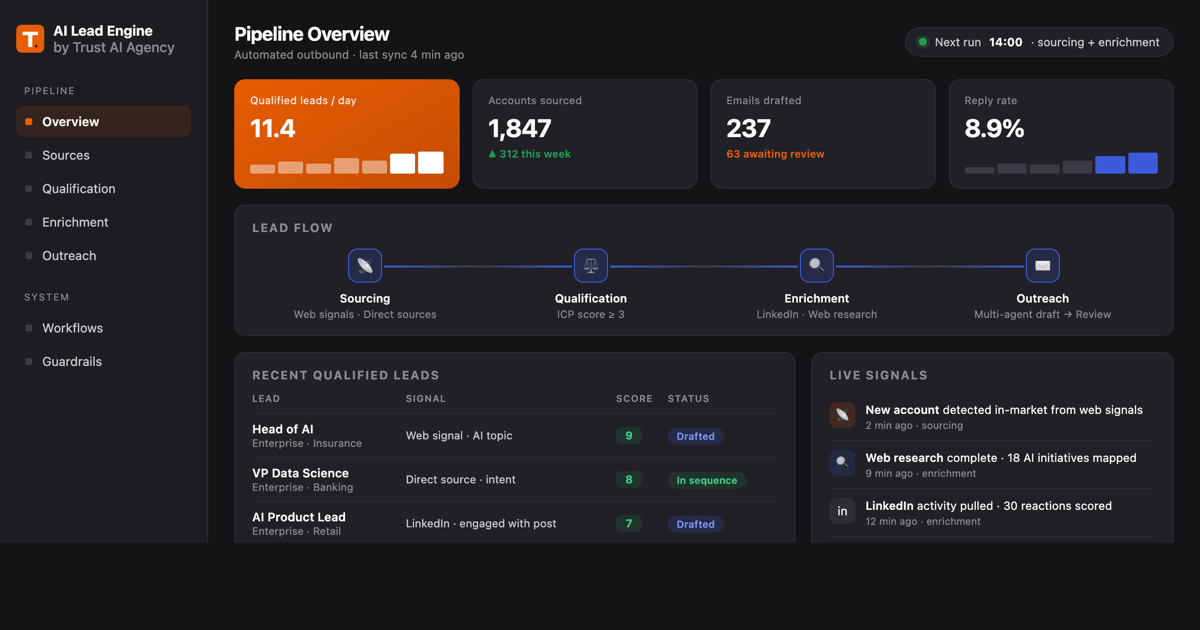
Our client, a B2B software company selling into large, regulated enterprises, had a sales team drowning in manual prospecting. Finding the right accounts, qualifying them, researching every contact, and writing a genuinely personalized first email took hours per lead. Off-the-shelf prospecting and automation tools each covered a fragment, but nothing connected sourcing, qualification, research, and outreach into one reliable flow.
The target was clear: 10 qualified leads a day. Hitting it by hand would have meant hiring an SDR team. The client wanted to hit it with automation instead, without sacrificing the personalization that makes outbound actually work.
We built an end-to-end lead engine on n8n: a set of always-on workflows that detect in-market accounts, score them against the client's ideal customer profile, enrich every contact with public and LinkedIn signals, and draft a personalized outbound email, then hand the best ones to a human for a final look before they go out.
The sales team wakes up to a queue of qualified, researched, ready-to-edit drafts instead of a blank prospecting list. The machine does the sourcing, scoring, research, and writing; the humans keep judgment and tone.
The engine sits on top of the client's existing stack and connects what used to be four disconnected steps into one observable flow. Each run pulls fresh accounts from every source, deduplicates them, scores each against the ICP, and drops anything below threshold, so only leads worth a human's time ever move forward.
On each scheduled run, the engine sources new accounts, scores them against the ICP, and enriches the qualified ones in parallel from LinkedIn profile and activity, web research, and direct sources. A multi-agent writer then identifies the persona and drafts a tailored email with several CTA options. Every step is logged, and guardrails screen each enriched profile before it ever reaches the model.
n8n is the orchestration layer, scheduled to run twice a day, with a shared working store, team notifications, and sequenced sending. Because every step (enrichment, research, model calls) sits behind its own node with logging and fallbacks, the client's team can see exactly where each lead is and why a draft reads the way it does.
Within weeks the engine was delivering the client's daily target on autopilot (qualified, enriched, and drafted) while a person stayed in the loop only for the final approval. The hours once spent on research per lead collapsed to minutes of review.
We built the engine so the client's team owns it. They tune the ICP scoring, edit the email prompts, and approve the drafts, while the automation handles the heavy lifting of sourcing, research, and writing while the humans keep control of judgment and voice. When the team later brought on a new business developer, onboarding meant pointing them at the review queue, not rebuilding a process.
Because the writing prompts are owned by the people who know the customers, the outbound never drifts into generic AI copy: every email opens on something real about the prospect and transitions smoothly into the client's value.
Sourcing, scoring, enrichment, and writing are separate, observable workflows, so the engine keeps getting better without a rebuild. New signal sources plug in as new sourcing workflows, the scoring threshold tightens as the client learns what converts, and the email prompts evolve campaign by campaign.
What started as a way to hit 10 qualified leads a day became durable outbound infrastructure the client runs on its own, with guardrails screening every enriched profile, so a poisoned or malicious input never reaches the model and the pipeline stays trustworthy as it scales.
Let's build a lead engine that fills your pipeline on autopilot
Book Your Strategy Call